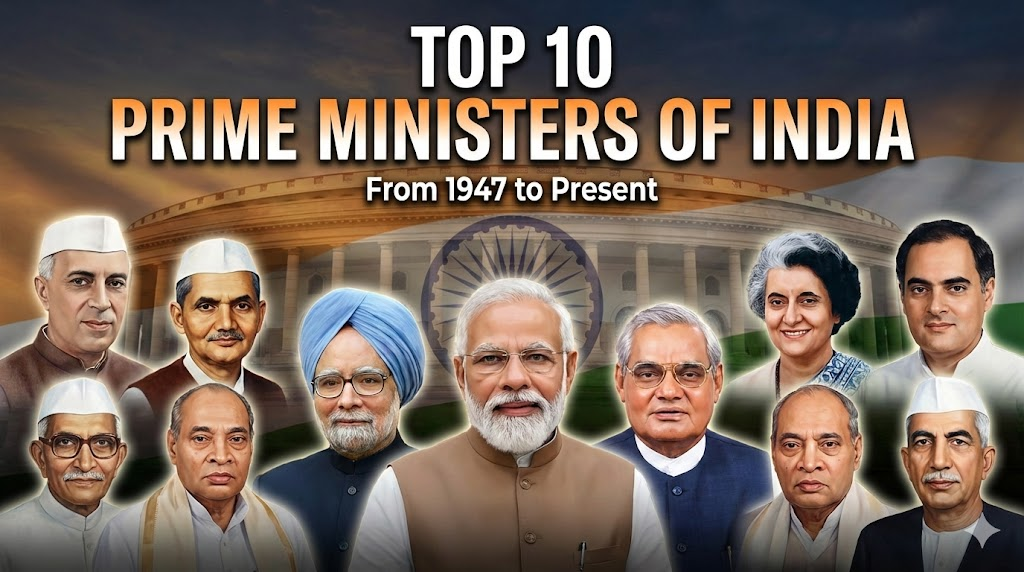
Top 10 Prime Ministers of India: Architects of a Nation
Date: February 17, 2026
Topic: Political History / Governance
Read Time: 12 Minutes
The office of the Prime Minister of India is not merely a constitutional post; it is the fulcrum upon which the world’s largest democracy balances. Since 1947, India has been led by 15 individuals (excluding acting PMs) who have steered the nation through wars, famines, economic crises, and global realignments. As we stand in early 2026, looking back at nearly eight decades of independence, the legacy of these leaders offers a panoramic view of India’s evolution from a fledgling state to a global superpower.
Selecting the “Top 10” is an exercise in analyzing impact, longevity, and the sheer magnitude of the challenges they overcame. While rankings remain subject to historical debate, the following ten leaders have arguably left the deepest footprints on the sands of Indian time. Their decisions—ranging from the integration of princely states to nuclear tests, and from economic liberalization to digital transformation—continue to define the India we live in today.
1. Jawaharlal Nehru
The Architect of Modern India
A. Overview
As India’s first and longest-serving Prime Minister, Jawaharlal Nehru did not just run a government; he built a nation. Taking charge of a country ravaged by partition and colonial exploitation, Nehru rooted democracy in soil that many predicted was too infertile for it. His vision was scientific, secular, and internationalist. He famously described the country’s dams and factories as the “temples of modern India,” emphasizing industrial self-reliance while nurturing democratic institutions that have survived all subsequent political storms.

B. Biodata
- Full Name: Jawaharlal Nehru
- Date of Birth: November 14, 1889
- Place of Birth: Allahabad, British India
- Death: May 27, 1964 (Age 74)
- Political Party: Indian National Congress
- Tenure: August 15, 1947 – May 27, 1964 (16 years, 286 days)
- Education: Trinity College, Cambridge; Inner Temple, London
C. Contribution & Impact
Nehru’s greatest contribution was the institutionalization of democracy. He established the Planning Commission, initiating Five-Year Plans that built India’s industrial base. His focus on education led to the creation of premier institutes like the IITs, IIMs, and AIIMS, which today fuel India’s global tech dominance. On the global stage, he was a founding father of the Non-Aligned Movement (NAM), ensuring India refused to be a pawn in the Cold War. While his handling of the Kashmir issue and the 1962 China war remain points of critique, his foundational work in keeping a diverse India united is unparalleled.
2. Narendra Modi
The Transformational Leader
A. Overview
Currently serving his third consecutive term in 2026, Narendra Modi has redefined Indian politics with a scale of ambition and execution rarely seen. Rising from humble beginnings, he ended the era of coalition instability in 2014 by securing a single-party majority for the BJP. His tenure has been marked by a shift from policy paralysis to aggressive implementation, focusing on infrastructure, digitization, and cultural resurgence. He is the longest-serving non-Congress Prime Minister and arguably the most popular global leader of the 21st century.

B. Biodata
- Full Name: Narendra Damodardas Modi
- Date of Birth: September 17, 1950
- Age (as of Feb 2026): 75
- Place of Birth: Vadnagar, Bombay State (now Gujarat)
- Political Party: Bharatiya Janata Party (BJP)
- Tenure: May 26, 2014 – Present
- Key Recognition: Consistently ranked World’s Most Popular Leader (75% approval rating in 2025)
C. Contribution & Impact
Modi’s “New India” is defined by tangible delivery and strategic autonomy. His administration oversaw the construction of over 40 million homes for the poor, the revocation of Article 370, and the digital revolution via UPI, which transformed the global payments landscape. Under his leadership, India became the world’s fifth-largest economy and landed Chandrayaan-3 on the moon’s south pole. His foreign policy has positioned India as a “Vishwa Bandhu” (Friend of the World), balancing ties with the West and the Global South.
3. Indira Gandhi
The Iron Lady of India
A. Overview
Indira Gandhi remains the most complex and powerful female figure in Indian history. Known for her decisiveness and centralization of power, she was adored by the masses as “Amma” (Mother) and feared by opponents for her ruthlessness. Her leadership during the 1971 war fundamentally altered the geography of South Asia. However, her legacy is a dual-edged sword, forever marked by the imposition of the Emergency in 1975, the only suspension of democracy in independent India’s history.

B. Biodata
- Full Name: Indira Priyadarshini Gandhi
- Date of Birth: November 19, 1917
- Place of Birth: Allahabad, United Provinces
- Death: October 31, 1984 (Assassinated at age 66)
- Political Party: Indian National Congress
- Tenure:
- Jan 24, 1966 – March 24, 1977
- Jan 14, 1980 – Oct 31, 1984
C. Contribution & Impact
Her defining moment was the 1971 liberation of Bangladesh, where she defied US pressure to secure a decisive military victory over Pakistan. Domestically, she championed the poor with her slogan Garibi Hatao (Remove Poverty), nationalizing banks and abolishing privy purses to reduce inequality. She also laid the groundwork for India’s nuclear status with the “Smiling Buddha” test in 1974. Despite the dark chapter of the Emergency, her return to power in 1980 proved her enduring connection with the Indian electorate.
4. Atal Bihari Vajpayee
The Statesman of Consensus
A. Overview
A poet, orator, and coalition builder, Atal Bihari Vajpayee was the first non-Congress Prime Minister to complete a full five-year term. He brought the political right to the center stage of Indian politics with a gentleness that earned him friends across the ideological spectrum. His tenure is remembered for balancing profound nationalism with economic pragmatism and peace initiatives.

B. Biodata
- Full Name: Atal Bihari Vajpayee
- Date of Birth: December 25, 1924
- Place of Birth: Gwalior, Gwalior State
- Death: August 16, 2018 (Age 93)
- Political Party: Bharatiya Janata Party (BJP)
- Tenure:
- May 1996 (13 days)
- 1998 – 1999 (13 months)
- 1999 – 2004 (Full term)
C. Contribution & Impact
Vajpayee boldly declared India a nuclear state with the Pokhran-II tests in 1998, weathering international sanctions with diplomatic finesse. He launched the Golden Quadrilateral highway project, which revolutionized India’s road infrastructure. His telecom policy laid the foundation for the mobile revolution. Diplomatically, he made sincere efforts for peace with Pakistan (Lahore Bus Yatra) but responded with steel during the Kargil War. His “coalition dharma” proved that a multi-party government could be stable and effective.
5. P.V. Narasimha Rao
The Father of Economic Reforms
A. Overview
Often called the “Licence Raj Slayer,” P.V. Narasimha Rao took office in 1991 when India was facing a severe balance of payments crisis. A scholar who reportedly spoke 17 languages, Rao ran a minority government yet managed to bulldoze through the most radical economic changes in India’s history. He is widely credited with saving India from economic collapse and setting it on the trajectory of high growth.

B. Biodata
- Full Name: Pamulaparthi Venkata Narasimha Rao
- Date of Birth: June 28, 1921
- Place of Birth: Warangal, Hyderabad State
- Death: December 23, 2004 (Age 83)
- Political Party: Indian National Congress
- Tenure: June 21, 1991 – May 16, 1996
C. Contribution & Impact
Rao dismantled the stifling License Raj, opened India to foreign investment, and liberalized trade. He appointed Manmohan Singh as his Finance Minister, providing the political cover needed for tough economic decisions. Beyond economics, he recalibrated India’s foreign policy, establishing full diplomatic ties with Israel and initiating the “Look East” policy to engage with Southeast Asia. His legacy is that of a quiet transformative force who changed India’s economic DNA forever.
6. Dr. Manmohan Singh
The Economic Architect
A. Overview
Dr. Manmohan Singh, who passed away in December 2024 at the age of 92, was the “accidental Prime Minister” who became the first since Nehru to be re-elected after a full five-year term. Renowned for his personal integrity and intellectual depth, Singh oversaw a decade of rapid economic growth and solidified the middle class. While his second term was marred by corruption scandals and policy paralysis, history remembers him kindly as the man who unleashed India’s economic potential.

B. Biodata
- Full Name: Dr. Manmohan Singh
- Date of Birth: September 26, 1932
- Place of Birth: Gah, Punjab (now Pakistan)
- Death: December 26, 2024 (Age 92)
- Political Party: Indian National Congress
- Tenure: May 22, 2004 – May 26, 2014
C. Contribution & Impact
As Prime Minister, Singh operationalized the Indo-US Civil Nuclear Deal, ending India’s nuclear apartheid and integrating it into the global nuclear order. His government launched rights-based legislation like the Right to Information (RTI) Act and the National Rural Employment Guarantee Act (MNREGA), which created a social safety net for millions. During his tenure, India witnessed its highest-ever GDP growth rates, averaging nearly 8% over a decade.
7. Lal Bahadur Shastri
The Hero of the Masses
A. Overview
Diminutive in stature but towering in resolve, Lal Bahadur Shastri succeeded Nehru and immediately faced a crisis of food shortage and war. He was a man of extreme simplicity and ethical rigour. His leadership during the 1965 war with Pakistan restored national pride after the 1962 defeat by China.

B. Biodata
- Full Name: Lal Bahadur Shastri
- Date of Birth: October 2, 1904
- Place of Birth: Mughalsarai, United Provinces
- Death: January 11, 1966 (Age 61)
- Political Party: Indian National Congress
- Tenure: June 9, 1964 – January 11, 1966
C. Contribution & Impact
Shastri gave India the immortal slogan “Jai Jawan, Jai Kisan” (Hail the Soldier, Hail the Farmer), emphasizing the dual importance of defense and agriculture. He endorsed the Green Revolution to make India food-surplus and supported the White Revolution (Amul) to boost milk production. His sudden death in Tashkent remains a subject of historical intrigue, but his brief tenure left an indelible mark of integrity on the office.
8. Rajiv Gandhi
The Modernizer
A. Overview
Thrust into power at age 40 after his mother’s assassination, Rajiv Gandhi remains India’s youngest Prime Minister. He represented a generational shift, bringing a passion for technology and modernization. Despite a massive mandate (400+ seats), his term was controversial due to the Bofors scandal and involvement in Sri Lanka, but his vision for a 21st-century India laid the groundwork for the IT boom.

B. Biodata
- Full Name: Rajiv Ratna Gandhi
- Date of Birth: August 20, 1944
- Place of Birth: Bombay, British India
- Death: May 21, 1991 (Assassinated at age 46)
- Political Party: Indian National Congress
- Tenure: October 31, 1984 – December 2, 1989
C. Contribution & Impact
Rajiv is rightly called the father of India’s IT and Telecom revolution. He introduced computers to India, lowered import tariffs on technology, and set up the C-DOT to revolutionize rural telecommunications. He also lowered the voting age from 21 to 18, empowering the youth, and strengthened local governance through the Panchayati Raj institutions (later constitutionalized).
9. Morarji Desai
The Restorationist
A. Overview
A staunch Gandhian and a disciplinarian, Morarji Desai holds the distinction of being India’s first non-Congress Prime Minister. Taking office at the age of 81 after the Emergency, his primary mandate was to dismantle the authoritarian machinery that had been built during the preceding two years.

B. Biodata
- Full Name: Morarji Ranchhodji Desai
- Date of Birth: February 29, 1896
- Place of Birth: Bhadeli, Bombay Presidency
- Death: April 10, 1995 (Age 99)
- Political Party: Janata Party
- Tenure: March 24, 1977 – July 28, 1979
C. Contribution & Impact
Desai’s government passed the 44th Constitutional Amendment, which reversed the draconian changes made during the Emergency and made it nearly impossible for any future leader to suspend democracy on frivolous grounds. He also promoted peace with neighbors, with Pakistan conferring its highest civilian award, Nishan-e-Pakistan, upon him.
10. V.P. Singh
The Catalyst of Social Justice
A. Overview
Vishwanath Pratap Singh, known as the “Raja of Manda,” had a short but seismically significant tenure. He broke away from the Congress to form a coalition government. His decision to implement the Mandal Commission report changed the caste dynamics of Indian politics forever, shifting the focus to social justice and representation for backward classes.

B. Biodata
- Full Name: Vishwanath Pratap Singh
- Date of Birth: June 25, 1931
- Place of Birth: Allahabad, United Provinces
- Death: November 27, 2008 (Age 77)
- Political Party: Janata Dal (National Front)
- Tenure: December 2, 1989 – November 10, 1990
C. Contribution & Impact
By implementing the Mandal Commission recommendations, V.P. Singh introduced 27% reservation for Other Backward Classes (OBCs) in government jobs. While it triggered massive student protests and political instability at the time, it empowered a vast section of India’s population and led to the rise of regional parties and OBC leadership in North India. His tenure effectively ended the upper-caste hegemony in Indian politics.
Comparative Analysis: Evolution of Leadership
The journey of India’s Prime Ministers reflects the maturing of the nation itself.
Economic Philosophy: The arc travels from Nehru’s Fabian socialism and protectionism, designed to build domestic capacity, to Indira’s populist nationalization. The inflection point came with Narasimha Rao and Manmohan Singh, who pivoted the nation toward liberalization and global integration. Today, Narendra Modi has synthesized these approaches into “Atmanirbhar Bharat”—encouraging domestic manufacturing (Make in India) while aggressively competing in the global export market.
Foreign Policy: Nehru’s India was the moral voice of the decolonized world (Non-Alignment). Indira Gandhi shifted this to hard realism, using military power to reshape borders. Vajpayee introduced the nuclear dimension, forcing the world to treat India as a security equal. Under Modi, the policy has evolved into “Multi-Alignment,” where India simultaneously engages with the US, Russia, and the Global South, acting as a pivotal swing power in geopolitics.
Social Engineering: While Nehru focused on legal equality and secularism, V.P. Singh brought caste-based social justice to the forefront. Rajiv Gandhi emphasized technological empowerment, and Modi has focused on “saturation governance”—ensuring welfare schemes (toilets, water, gas, digital access) reach the last mile, creating a new class of beneficiaries (Labharthis) that transcends traditional caste lines.
Conclusion
Ranking these ten leaders reveals that no single ideology has built India. It was Nehru’s institutions, Shastri’s resilience, Indira’s grit, Rao’s intellect, Vajpayee’s consensus, and Modi’s ambition that collectively forged the modern republic. As India marches toward 2047, the centenary of its independence, the foundations laid by these ten architects remain the bedrock upon which the nation’s future is being constructed. Each leader, with their distinct strengths and flaws, was the necessary answer to the specific questions their era asked of them.